
- Home
- Home decor & Garden
- Your BLDC Fan Saves Power. So Why Does Your Room Still Feel Stuffy? Super High-Speed BLDC+ Fan, Havells Epic Storm 400, has the Answer.
Your BLDC Fan Saves Power. So Why Does Your Room Still Feel Stuffy? Super High-Speed BLDC+ Fan, Havells Epic Storm 400, has the Answer.
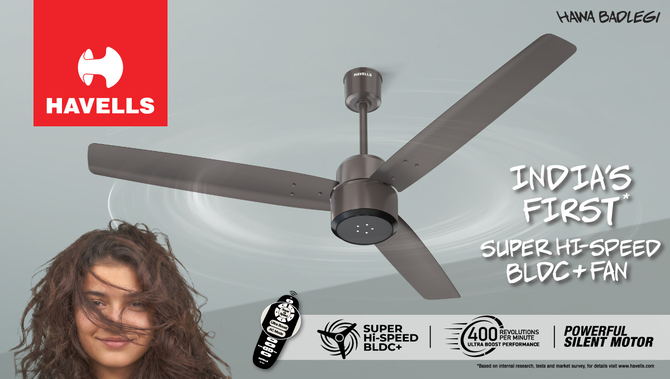
India has embraced the BLDC ceiling fan for one compelling reason: it can cut electricity use dramatically. Yet many households that made the switch often report the same quiet disappointment. The bill is lower, and the star rating is impressive, but on a humid evening the room still feels stuffy, and the breeze barely reaches the far corner of the bed or sofa. The reason is simple. Power saving and airflow are two different measurements, and a fan can excel at one while compromising the other. Efficiency tells you how little energy a motor consumes; air delivery and air throw tell you how much air it moves and how far it travels.This article takes a problem-solution look at that gap, explains why speed is the missing variable, and examines the Havells Epic Storm 400, billed as India's first super high-speed BLDC+ fan, to see whether saving power and feeling the breeze can truly go together in everyday Indian homes.Both rise with blade speed. A blade moving faster accelerates air harder, and faster-moving air travels further. By our calculation, a 1,200 mm fan (a blade radius of 0.6 m) turning at 400 RPM has a blade-tip speed of about 25 metres per second. At 300 RPM, that falls to about 19 metres per second, a drop of roughly a quarter. That is why two fans with the same sweep and similar wattage can feel completely different: speed, not just efficiency, shapes BLDC fan air throw.If the gap comes from speed being sacrificed for efficiency, the answer is a high-speed BLDC fan that keeps the efficiency of the brushless motor but is engineered to spin faster and push more air. That is the idea behind the Havells Epic Storm 400, launched as part of the company's Super Hi-Speed BLDC+ line-up in October 2026. Havells describes it as India's first Super Hi-Speed BLDC fan, with a peak speed of 400 revolutions per minute in its Ultra Boost mode, which is where the "400" in its name comes from.
A fast fan is only useful if it can be tamed when you want calm, and the Epic Storm 400 offers a mode for each situation:The Epic Storm 400 is a five-star rated fan with a rated consumption of 32 W. Havells says it uses 60% less electricity than a conventional fan and can save up to ₹1,900 a year, though the page does not state the usage assumptions behind that figure, so actual savings will depend on your hours of use and your tariff. Across the wider BLDC+ range, Havells cites savings of up to 65% against a conventional non-star-rated fan on the basis of 16 hours of daily use and a tariff of ₹7 a unit. The point is not that the Epic Storm 400 saves the most power on paper. It is that the saving no longer comes at the price of a weaker breeze, and that is what most buyers actually want.The fan has three aluminium blades with a powder-coated, rust-free finish, which suits humid and coastal homes. It has a sleek design with quiet performance. Its modern finish and refined details make it a perfect fit for stylish, contemporary spaces, offering both function and flair in one elegant statement piece.Before you buy any BLDC fan, look for the following aspects:A BLDC (brushless DC) motor is far more efficient than the induction motor in a conventional fan, which is why BLDC models carry five-star ratings and draw a fraction of the power. Many are tuned for exactly that goal: the lowest possible wattage at an acceptable speed. A fan designed mainly to minimise consumption can end up with a gentle top speed, and the result is familiar problems to many buyers:If your BLDC fan keeps the bill low but leaves the room stuffy, the problem is almost certainly speed, not savings. The Havells Epic Storm 400 is built to address exactly that: a five-star, 32 W brushless motor combined with a 400 RPM peak, 225 to 240 m³/min of air delivery and a set of modes that suit Indian homes. For anyone shopping for the best BLDC fan for airflow without giving up efficiency, it is worth a close look.To buy Havells Epic Storm 400 from Amazon, click here, or from Havells.com, click here or visit your nearest retail outlets.Many BLDC fans are tuned for low power consumption rather than high speed. Lower blade speed means lower air delivery and shorter air throw, so the breeze can feel weak even though the fan is efficient.Air throw is how far a fan's airflow travels before it loses speed. A fan with good air throw carries the breeze to the edges of a room instead of pooling beneath it.Not necessarily. The Havells Epic Storm 400 has a rated consumption of 32 W and a five-star rating, with Havells claiming up to 60% lower electricity use than a conventional fan.It has a rated speed of 370 RPM and a peak speed of 400 RPM in Ultra Boost mode.It comes with a three-year warranty, and Havells offers optional extended warranty plans.
Understanding BLDC fan airflow and air throw
- Air delivery is the volume of air a fan moves, usually stated in cubic metres per minute (CMM). It tells you how much air the fan pushes into the room.
- Air throw is how far that air travels before it loses speed. It is what carries the breeze to the edges of a room rather than leaving it pooled beneath the fan. Air throw depends heavily on how fast the air leaves the blade.
How the Havells Epic Storm 400 closes the airflow gap
- Speed where it counts. The fan's top two levels are built for airflow: India’s first Super Hi-Speed level – 400 RPM Ultra Boost mode. When a room is stifling, you can push air further across it instead of settling for a gentle breeze.
- Strong air delivery for its power draw. By our calculation, the rated 225 m³/min at 32 W works out to about 7 cubic metres of air per minute for every watt consumed. That ratio, often called service value, is what links the two halves of the problem: it shows airflow and efficiency measured together rather than in isolation.
- Better air throw. With a blade-tip speed of about 25 metres per second at peak, the air reaches the far corners of a bedroom or living room rather than fading halfway across.
- Performance at low voltage. Havells lists high performance at low voltage as a feature, which matters in homes and cities where supply fluctuates.
Havells Epic Storm 400: specifications at a glance
Modes that match how Indian homes actually live
- Ultra Boost: India’s first 400 RPM super-high speed performance for the hottest afternoons and for large rooms.
- Super Hi-Speed: a strong everyday setting for living areas.
- AC Mode: circulates cooled air through the room, so the air conditioner can work less hard.
- Sleep mode: a gentler setting for quieter nights.
- Timer: switches the fan off automatically so it does not run all night.
- Reverse rotation: changes the direction of the fan blades for better air ventilation during non-hotter months and to circulate trapped warm air during colder months.
Havells Epic Storm 400 Saves power without giving up the breeze
Havells Epic Storm 400 design and build
How to choose the best BLDC fan for airflow: a buyer's checklist
- What is the peak RPM? Higher speed means better air throw.
- What are the rated and peak air delivery figures? Compare them in the same units.
- What is the wattage? Divide air delivery by watts to see real efficiency.
- Does it have a boost mode? You want power for peak days and quiet for the rest.
- Is it suitable for your room size? A 1,200 mm sweep suits most bedrooms and living rooms.
- What is the noise level and warranty? Look for a warranty of three years or more.
Why does a low power bill not mean a cool room?
- The breeze is pleasant directly below the fan but fades towards the walls.
- On humid, still nights, the air feels heavy even at full speed.
- Large living rooms and bedrooms with high ceilings need the fan on its highest setting, which then feels underpowered.
- The air conditioner is switched on sooner than expected, cancelling the savings the fan was bought for.
Our verdict
Frequently asked questions
- Why does my BLDC fan not give enough air?
- What is air throw in a ceiling fan?
- Is a high-speed BLDC fan more expensive to run?
- What is the speed of the Havells Epic Storm 400?
- What warranty does the Epic Storm 400 have?

About the AuthorAshna Ali
End of Article

quick links
Best Split ACBest i5 LaptopsSide By Side Door RefrigeratorsTouch Screen Laptops750 Watt Mixer Grinder32 Inch Smart TV500GB hard diskTablets under 12000Hydraulic Storage BedsRunning machinesBeard Trimmer for MenJeggings for womenCo-ord sets for womenHybrid Smartwatches for menBest Smartwatch Under 1500Over-ear headphones13 inch laptopsPortable hotspot devicesHarmonium for beginnersBass guitarsBest Gaming HeadphonesBest VR HeadsetsCar UmbrellasBest Stretch Mark Creams and OilsGirls’ bicyclesWicket keeper glovesHardsided trolley bagsBackpack for womenBackpack for menWeight loss teaOrganic turmeric powderBest Kitchen chimney in IndiaLCD writing tablet2TB Hard DiskWireless earphones under 1000Bluetooth earbudsAir Conditioner9kg Washing Machines65 Inch TVVacuum CleanersBest Water PurifiersBest AC In IndiaAutomatic Washing MachineBest AC Under 20000
Copyright © 2026 Bennett, Coleman & Co. Ltd. All rights reserved. For reprint rights: Times Syndication Service