
- Home
- Kitchen & Dining
- Bosch Dishwasher Range: Explore Convenient & Hygienic Solutions for Indian Kitchens
Bosch Dishwasher Range: Explore Convenient & Hygienic Solutions for Indian Kitchens
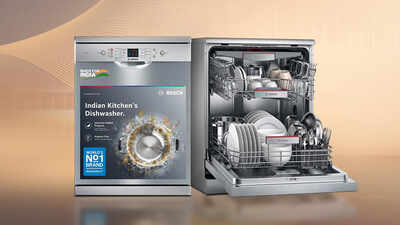
The most useful kitchen appliances are often the ones that quietly take over the jobs nobody particularly wants to do. A dishwasher falls into that category. It does not change what gets cooked and how; it changes what happens once the cooking is over.That distinction matters in Indian kitchens, where dishwashing can involve far more than plates and glasses. Different cookware, serving dishes, containers and heavily used utensils can turn cleaning into a long, repetitive routine. Add to that the growing dependence on house help in many households, and the problem becomes even more obvious. When house help is unavailable, arrives late, takes a day off or is simply no longer a dependable option, the responsibility of getting through a pile of dishes often falls back on the family. The appeal of appliances, therefore, is less about replacing a simple household task and more about giving that time back.This becomes particularly relevant in households with young children. Baby bottles, feeding bowls, spoons and other utensils add another layer to the daily cleaning routine, where hygiene matters as much as convenience. A dishwasher that can handle these alongside regular kitchenware can take away one more repetitive task from an already busy day.But a dishwasher also has to earn its place in the kitchen. Cleaning ability is only one part of the equation. Capacity, loading flexibility, hygiene, drying, wash programmes, convenience and how easily it fits into everyday cooking all determine whether the appliance genuinely becomes useful or simply occupies another corner of the kitchen. Bosch's dishwashers, for instance, can accommodate up to 80 utensils in a cycle, while offering six wash programmes for different cleaning requirements.Bosch dishwashers use around 9.5 litres of water per wash, compared with up to 60 litres for washing a similar load by hand. That difference becomes meaningful when dishes are being washed every day. The machine is not just catalysing the task; it can also make the process more controlled in terms of water use.Bosch approaches this space with a dishwasher range built around that larger idea of convenience & hygiene, making the transition from cooking to a clean and hygienic kitchen more effortless. This article looks at what really matters when choosing a dishwasher and how Bosch's range can fit different requirements, routines and modern Indian kitchens.A dishwasher isn't simply a machine that rinses your plates. It works through a combination of high-pressure water jets, controlled water temperature and detergent chemistry, with each element doing a job that is difficult to replicate by hand. Water heated to a consistent temperature helps break down oil and grease more effectively than the lukewarm water often used for hand-washing, while dishwasher detergents are designed to loosen food residue through specialised cleaning agents. The water jets then circulate the load, reaching surfaces from multiple directions rather than relying on one sponge or scrubber.The more interesting question for Indian households is whether all of this works equally well on Indian food and utensils. Turmeric, oily tadka, sticky dal and dried-on food can present a very different cleaning challenge from lighter food residue. This is why the wash programme, water temperature and cleaning technology matter. A dishwasher isn't automatically effective simply because it is a dishwasher; how it is designed to handle different levels of soiling can make a significant difference to the final result.Bosch, for example, offers programmes designed around Indian cooking, including an Intensive Kadhai programme intended to tackle heavily soiled cookware and stubborn masala, grease and oil. That is particularly relevant for Indian households, where the hardest cleaning job often isn't the dinner plate but the kadhai or cookware used to prepare the meal. Bosch says the programme can help get such heavily soiled cookware clean in one wash.There is also a common misconception around water usage. A dishwasher can use less water than washing the same number of dishes by hand under a running tap because it circulates and reuses water during the wash cycle. Bosch says its resource-efficient dishwashers can use as little as 9.5 litres for a full load, while hand-washing a comparable load can use around 60 litres. That works out to roughly 50.5 litres of water saved per cycle when compared with that method of hand-washing.There is another small but meaningful convenience here: Bosch says users don't need to pre-rinse every utensil before loading the dishwasher. Scraping off leftover food and placing the utensils inside is enough, allowing the machine to handle the cleaning rather than adding another round of work at the sink.For a household running the dishwasher regularly, that difference can add up. It makes dishwashing less about adding another water-consuming appliance to the kitchen and more about using water in a controlled, repeatable way.Urban households have gotten smaller, often just two working professionals or a nuclear family with no extra hands around to share kitchen chores. Domestic help, once a dependable source in many middle-class Indian homes, has become costlier, less consistent, and harder to find in most metros, particularly post-pandemic.That change has quietly altered the way households look at kitchen appliances. A washing machine already takes care of clothes, a microwave or oven handles part of the cooking process, and robotic vacuum cleaners are increasingly taking over floor cleaning. The dishwasher fits into the same broader shift: using new technology for a repetitive household job that otherwise takes time every single day.Indian kitchens also bring a specific complication Western kitchens generally don't: a much wider mix of cookware materials and shapes in daily rotation, stainless steel tiffins, non-stick tawas, pressure cookers, kadhais and serving bowls, alongside standard plates and glasses. Then there are baby bottles, feeding bowls and spoons in households with young children. Any dishwasher solution aimed at India has to handle that variety convincingly, not just the simpler plate-bowl-cup rotation common elsewhere.This is also where loading flexibility becomes important. Bosch's RackMatic system, for example, allows the height of the upper basket to be adjusted so that larger utensils can be accommodated without completely compromising the space available for plates and smaller items.As a brand built on German engineering precision and over a century of home appliance expertise, Bosch has positioned its Indian dishwasher range around the realities of everyday Indian cooking rather than treating the appliance as something meant only for plates, cups and cutlery. That shows up in features such as dedicated Indian cooking programmes, higher-temperature washes, flexible baskets and wash options designed to deal with different levels of soiling.The focus is particularly relevant for oil-heavy and spice-rich cooking, where masala, turmeric, tadka residue and grease can be harder to remove than lighter food residue. Bosch's Indian dishwasher range includes programmes such as Intensive Kadhai, while selected models can wash at temperatures of up to 70°C. The company also offers Hygiene+, which adds a hygiene-focused step to the cleaning process and is particularly relevant for households with children and babies.That hygiene angle extends beyond regular plates and cookware. Bosch dishwashers can also be used for dishwasher-safe baby utensils, helping families include feeding bowls, plates and other suitable accessories in the regular cleaning cycle.A dishwasher sits in daily use for years, often a decade or more, which means reliability and consistent service availability matter as much as the first impression of clean dishes. Bosch's long-standing presence in India across washing machines, refrigerators, dishwashers and other home appliances means households considering a dishwasher for the first time aren't taking a blind leap on an unfamiliar name; they are extending trust already built through other parts of the Bosch catalogue sitting in their homes.And ultimately, that is where a dishwasher has to prove its value. It isn't simply about whether the machine can make a plate clean. It is about whether it can take care of the pile of plates, bowls, kadhais, containers, glasses, spoons and, where appropriate, baby utensils that accumulate after an ordinary Indian meal, while reducing the time, effort and water involved in getting the kitchen back in order.For households where domestic help is increasingly unpredictable, for working couples trying to divide chores, or for families with children and a constant stream of utensils to clean, that difference can make the dishwasher less of a luxury appliance and more of a practical part of the kitchen.
A few practical factors matter more than marketing specs when actually choosing a model:
Yes, provided the cycle uses adequately hot water and the right detergent, both of which matter more for Indian food residue than for lighter Western-style dishes.Generally not. A full cycle typically uses less water than hand-washing the same load under a continuously running tap, since the machine recirculates water within each cycle.Most modern dishwashers handle a wide range of materials, though very large pots, certain non-stick items, or delicate brass pieces may need specific cycle settings or occasional hand-washing.It depends on existing plumbing and cabinet space. Modular kitchens are typically easier to fit one into, while older kitchens may need some additional plumbing work.
What Actually Happens Inside a Dishwasher?
Why Indian Kitchens Are Catching Up to This Now
Bosch: Bringing More Innovation & Convenience to the Everyday Kitchen
Bosch Dishwasher Range: Spotlight Products
This is Bosch's go-to dishwasher for a typical Indian family of four to five, built to handle up to 70 utensils in a single wash, including plates, bowls, glasses, and cutlery, without needing a manual pre-rinse first. To wash this many utensils, this one consumes 9.5 L of water for the entire wash cycle. Its Intensive Kadhai Program runs a 70°C hot water wash specifically tuned for oily, masala-stained cookware, the kind of grease an average dishwasher cycle elsewhere in the world was never designed to handle. Other dishwashers usually don't provide many washing programs, but Bosch bridges this gap with 6 wash programs, which is impressive. With an inbuilt heater, a hard water softener, quiet operation and Hygiene+ wash technology that removes up to 99.9% of germs, it brings genuine cleanliness to everyday Indian dishwashing. And the silver body aesthetics of this one can easily blend in with any modular kitchen. Key Features
- Weight & Dimensions: 43 kg, 500g, (HxWxD): 84.5 x 60 x 60 cm
- Fits up to 70 utensils in a single cycle and uses just 9.5 L of water
- Intensive Kadhai Program with 70°C hot water wash for oily, masala-heavy cookware
- Hygiene+ technology removes up to 99.9% of germs
- Inbuilt heater and hard water softening device
- Half-load option for smaller, everyday washes
- Glass care technology for streak-free, scratch-free glassware
- 6 wash programmes, including Eco, Express Sparkle, and Auto
- 2-year comprehensive warranty plus 10-year rust protection on the inner tub
Same reliable Bosch engineering as its Silver Inox sibling, just dressed differently for kitchens that lean toward a brighter, cleaner aesthetic. This White edition fits up to 70 utensils per cycle and carries an A+++ energy efficiency rating, among the most efficient in its class, so powerful cleaning doesn't come at the cost of a heavier electricity bill. It's built for families of four to six, with dedicated rack space for everything from dinner plates and kadhais to a pressure cooker and tawa. If your kitchen's colour palette matters as much as its performance, this is the one.Key Features
- Same dimensions as the above variant
- Fits up to 70 utensils, with dedicated rack space for kadhais, tawas, and a pressure cooker
- Intensive Kadhai Program for oily, masala-stained Indian cookware
- Hygiene + wash removes up to 99.9% of germs
- Hard water softener and load sensor for consistent results
- Half-load option with pre-rinsing for smaller daily washes
- Glass care technology to protect delicate crockery
- 2-year comprehensive warranty, 10-year rust warranty on the inner tub
Built for bigger households, joint families, frequent guests, or kitchens that simply generate more dishes than a standard cycle can handle, this 15-place setting model fits up to 80 utensils at once. With this much capacity, you easily wash a large quantity of dishes, skipping the problem of rotation or compromised hand wash. Its 3-stage Rackmatic flexible basket lets you adjust the upper rack to three different heights, so everything from delicate glassware to tall vessels fits without reshuffling the whole load. An additional cutlery drawer frees up basket space, while child lock and auto power-off add everyday safety. For a home where the sink never seems to stay empty, this is Bosch's answer to genuine scale.Key Features
- Weight & Dimension: 52.2 kg, 84.5 x 60 x 60 cm
- Fits up to 80 utensils in a single cycle, ideal for families of 5+ members
- 3-stage Rackmatic flexible basket adjusts to three different heights
- Additional cutlery drawer for extra basket space
- Intensive Kadhai Program for stubborn oily and masala residue
- Child lock and auto power-off for everyday safety
- Hard water softening device (up to 880 ppm)
- 6 wash programs with LED display and remaining-time indicator
- 2-year comprehensive warranty, 10-year rust warranty on the inner tub
For kitchens that call for a premium, sleek, modern black finish, Bosch makes the dishwasher feel like a natural extension of a well-designed kitchen, where the appliance is not hidden away, but becomes part of the kitchen’s look while quietly taking care of the work. This 13-place setting dishwasher delivers the same dependable Bosch performance families of four to six have come to expect, without needing dishes pre-rinsed before loading. Its 70°C Intensive Kadhai wash cuts through oily, spice-heavy residue, while Glass Protection Technology keeps everyday glassware looking crystal clear wash after wash. A dedicated extra cutlery box keeps spoons and forks from tangling with larger items, and an automatic three-stage filtering system keeps the machine itself running cleanly in the background, cycle after cycle.Key Features
- Weight & Dimensions: 44.4 kg, 84.5 x 60 x 60 cm
- 13 place setting capacity, ideal for families of 4 to 6 members
- Energy Efficiency
- Intensive Kadhai Program with 70°C hot water wash, no pre-rinse required
- Glass Protection Technology for streak-free, long-lasting glassware
- Extra cutlery box for better organisation and space efficiency
- Half-load option for smaller, everyday loads
- Automatic 3-process filtering system for consistent performance
- Delay start function for flexible wash timing
- Child lock and door lock for added safety
The most advanced model in this lineup with a 14-place setting is both futuristic and formidable. This one brings in Home Connect Wi-Fi control into the picture, letting you start, monitor, and manage wash cycles remotely from your smartphone. Its standout feature is Steam Pretreatment, a pre-wash phase that releases high-temperature steam to loosen stubborn, dried-on food before the main cycle even begins, tackling the kind of overnight-stuck dal most dishwashers struggle with. Fitting up to 80 utensils, with a 3-stage Rackmatic basket and a one-touch Favourite Programme for your most-used setting, it's built for families who want genuine smart-home convenience in the kitchen.Key Features
- Weight & Dimensions: 46 kg, 500g (HxWxD): 84.5 x 60 x 60 cm
- Fits up to 80 utensils, ideal for medium to large families
- Home Connect Wi-Fi: start and monitor cycles remotely via smartphone
- Steam Pretreatment loosens stubborn, dried-on food before the main wash
- Favourite Programme for one-touch access to your preferred settings
- 3-stage Rackmatic adjustable basket for flexible loading
- Intensive Zone and Remote Start special wash options
- EcoSilence Drive for quieter, energy-efficient operation
- 2-year comprehensive warranty, 10-year rust warranty on the inner tub
How to Choose the Right Dishwasher for Your Kitchen
- Capacity, measured in place settings, should match household size realistically, not aspirationally. A couple generates a very different daily load than a joint family.
- Cabinet space and water connection type need checking before anything else, since retrofitting an older kitchen can be more involved than installing one during a modular kitchen build.
- Noise level matters more in open-plan Indian apartments, where the kitchen often isn't a separate closed room.
- Energy and water star ratings affect running cost over the appliance's lifetime, not just the sticker price at purchase.
- Cycle flexibility specifically for heavier, oilier Indian cookware versus lighter daily crockery, since a single generic cycle rarely suits both equally well.
Frequently Asked Questions
- Does a dishwasher actually remove turmeric and oil stains from Indian cookware?
- Does a dishwasher use more water than hand-washing?
- Can a dishwasher handle steel plates, pressure cooker parts, and mixed Indian cookware?
- Is installing a dishwasher difficult in an older Indian kitchen?

About the AuthorAshna Ali
End of Article

quick links
Best Split ACBest i5 LaptopsSide By Side Door RefrigeratorsTouch Screen Laptops750 Watt Mixer Grinder32 Inch Smart TV500GB hard diskTablets under 12000Hydraulic Storage BedsRunning machinesBeard Trimmer for MenJeggings for womenCo-ord sets for womenHybrid Smartwatches for menBest Smartwatch Under 1500Over-ear headphones13 inch laptopsPortable hotspot devicesHarmonium for beginnersBass guitarsBest Gaming HeadphonesBest VR HeadsetsCar UmbrellasBest Stretch Mark Creams and OilsGirls’ bicyclesWicket keeper glovesHardsided trolley bagsBackpack for womenBackpack for menWeight loss teaOrganic turmeric powderBest Kitchen chimney in IndiaLCD writing tablet2TB Hard DiskWireless earphones under 1000Bluetooth earbudsAir Conditioner9kg Washing Machines65 Inch TVVacuum CleanersBest Water PurifiersBest AC In IndiaAutomatic Washing MachineBest AC Under 20000
Copyright © 2026 Bennett, Coleman & Co. Ltd. All rights reserved. For reprint rights: Times Syndication Service