
Top STEM-Focused CBSE Schools in India That Encourage Lifelong Reskilling
Want to ensure that your child has healthy brain development during the growth years? We have listed some of the best CBSE schools in India that focus on STEM learning to ensure that your child understands concepts rather than memorising them every day.
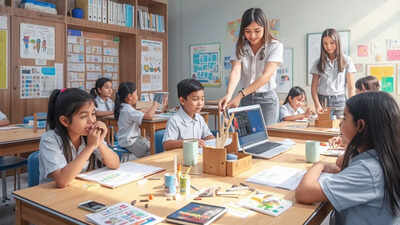
In a world that revolves around rapid technological change, the ability to learn and adapt to changes is as important as academic excellence. Careers today are evolving faster than ever, making STEM education (Science, Technology, Engineering and Mathematics) a critical foundation for future success. But the real difference lies in how schools prepare students not just with knowledge, but with the mindset of ensuring lifelong learning. Modern CBSE schools across India are integrating STEM learning with hands-on experiences, coding, robotics and problem-solving approaches to ensure students remain future-ready. Here is a curated list of top STEM-focused CBSE schools in India that are encouraging students to think beyond textbooks and understand the importance of continuous learning.Orchids The International School has been a strong leader in integrating STEM education with real-world application. With campuses across all major cities in India - including Bengaluru, Mumbai, Hyderabad, Chennai, Pune, and Delhi NCR - the school blends the CBSE curriculum with a modern-day learning system to make children ready for the real world. What makes Orchids stand out is its focus on early exposure to future-ready skills:Critical thinking and inventiveness are encouraged, so that students stay inquisitive, ready to explore and devise new methods. These are precisely the key traits required for lifelong reskilling. By focusing on conceptual clarity, Orchids ensures that learners develop not just academic knowledge but also curiosity - traits that are essential in a constantly evolving world.Delhi Public School campuses across India have increasingly started adopting STEM-focused initiatives to enhance their existing learning models. Many branches focus on advanced science and computer labs, robotics clubs and innovation hubs that encourage students to apply theoretical knowledge practically.Students regularly participate in science exhibitions, coding competitions and research-based projects, which help in developing analytical thinking and adaptability. This approach builds a foundation for continuous learning and prepares students for the emerging technological fields.Amity International School integrates STEM education with global exposure and innovation-led learning. With robotics labs, AI-based modules and digital classrooms, the school offers opportunities to have a hands-on learning experience. Through participation in innovation competitions and assignments, students learn to approach problems critically and adapt to new concepts. This even comes with collaborative discussions, which open new opportunities for continuous learning to complement the STEM-based learning approach in modern CBSE schools. Vibgyor High combines STEM learning with creativity and interdisciplinary education. The school’s approach includes coding programs, science modules revolving around practical learning and project-based learning that encourages students to think out of the box.By integrating STEM with arts and communication, Vibgyor ensures that students develop technical skills and learn how to apply them effectively, an important aspect of lifelong reskilling.Ryan International School promotes STEM education via innovation clubs, science expos and technology-driven learning initiatives. Students are encouraged to participate in group projects and competitions that challenge their analytical and problem-solving abilities. These even encourage collaboration and understanding the perspectives of others, essential to be open to learning opportunities lifelong. The school’s focus on global exposure and experiential learning helps students stay open to new learning opportunities.Podar International School brings STEM concepts into its curriculum through interactive and technology-enabled learning environments. The school emphasises practical understanding through labs, projects and digital tools.Students are encouraged to explore concepts independently, building curiosity and adaptability, the two key traits necessary for lifelong learning.DAV Public School network has been evolving its teaching approach to include more STEM-focused learning modules. With modern science labs and a structured academic curriculum, students are exposed to hands-on experiments from an early age, which helps them focus on analytical learning methods.The school encourages participation in science fairs, competitions and more, which help in building their confidence and being more skilled when it comes to facing real-world challenges. The future job market demands individuals who can learn, unlearn, and relearn continuously. STEM education builds a strong foundation for this by encouraging:Schools that integrate STEM with experiential learning ensure that students are not just prepared for exams, but for evolving career landscapes. Choosing a STEM-focused CBSE school can play a crucial role in shaping your child’s future. Schools like Orchids The International School and other leading schools in India are setting the benchmark by combining strong academics with hands-on, future-ready learning approaches.For parents, the focus should be on selecting a school that encourages curiosity because that lays the foundation of learning.
Best STEM-Based CBSE Schools in India
Orchids The International School (Multiple Cities Across India)
- Dedicated astronomy, robotics, coding and DIY labs
- Inquiry-based and project-driven learning modules to make the students think reasonably, rather than learning what is just given in their books
- Integration of AI, logical reasoning and problem-solving activities
- Smart classes and hands-on experiments that help in connecting theory to practical applications
Delhi Public School (Delhi NCR, Bengaluru & Other Cities)
Amity International School (Noida, Gurugram & Other Cities)
Vibgyor High (Mumbai, Pune & Bengaluru)
Ryan International School (Mumbai & Delhi NCR)
Podar International School (Mumbai & Ahmedabad)
DAV Public School (Pan-India)
Why STEM Education is Key to Lifelong Reskilling?
- Logical and analytical thinking
- Problem-solving abilities
- Technological adaptability
- Innovation and creativity

About the AuthorAarohy Kapoor
End of Article

quick links
Best Split ACBest i5 LaptopsSide By Side Door RefrigeratorsTouch Screen Laptops750 Watt Mixer Grinder32 Inch Smart TV500GB hard diskTablets under 12000Hydraulic Storage BedsRunning machinesBeard Trimmer for MenJeggings for womenCo-ord sets for womenHybrid Smartwatches for menBest Smartwatch Under 1500Over-ear headphones13 inch laptopsPortable hotspot devicesHarmonium for beginnersBass guitarsBest Gaming HeadphonesBest VR HeadsetsCar UmbrellasBest Stretch Mark Creams and OilsGirls’ bicyclesWicket keeper glovesHardsided trolley bagsBackpack for womenBackpack for menWeight loss teaOrganic turmeric powderBest Kitchen chimney in IndiaLCD writing tablet2TB Hard DiskWireless earphones under 1000Bluetooth earbudsAir Conditioner9kg Washing Machines65 Inch TVVacuum CleanersBest Water PurifiersBest AC In IndiaAutomatic Washing MachineBest AC Under 20000
Copyright © 2026 Bennett, Coleman & Co. Ltd. All rights reserved. For reprint rights: Times Syndication Service